
Why A Conservative?
A view into my personal perspective shaped by the past; not seeking to reshape the past and its values or lessons.

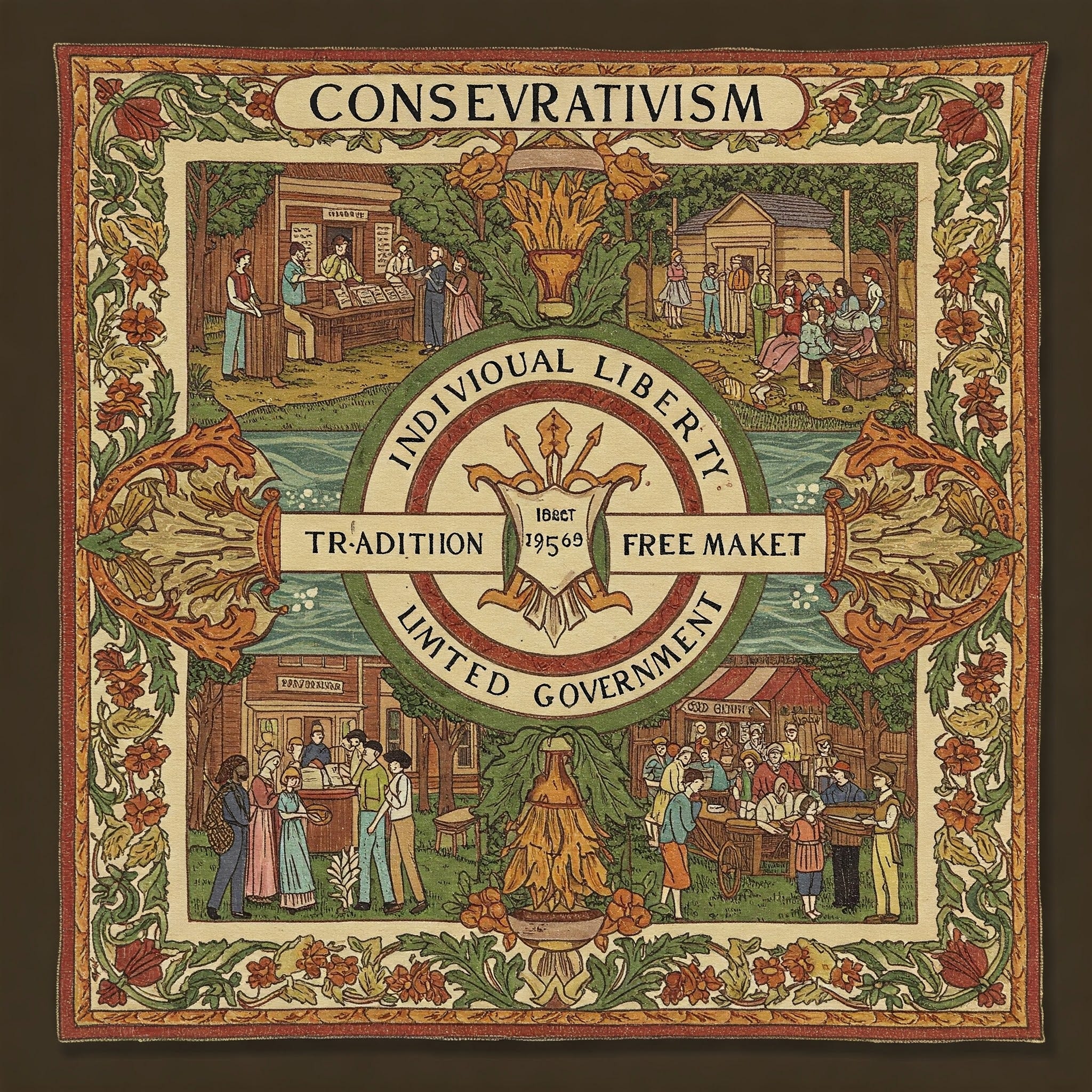
Intro:
Oftentimes, people form their beliefs not on a thing they support, but because of a reaction to things they could never support. Many conservatives would feel that they had the obligation to oppose such things as abortion, transgenderism, or mass migration that they felt was harming the country or civilization; and because of this reaction, they land in the camp of Conservatism. But, this is not necessarily the right approach. For a better understanding of these sides and reasonings behind the individuals’ choices, history is a great source. In this article, we will be investigating the political expressions between the two main groups, the arguments for the virtue of the West, and the benefit of slow progress over a rapid reactionism.
Looking at the Past: Good and Bad in Society
Of course, History shows a lot about the battle between progressives, liberals, conservatives, monarchists, republicans, and etc. Not that these all hold the same meaning over time, but these are the different types of labels that have been used to represent different views—even ones that change drastically over time. For example, early conservatives look drastically different to modern conservatives. This is easily seen when comparing the modern Republican party with the modern Democrat party (US, of course); for, in removing the times as a factor, they have completely flopped their allegiances and views. Democrats used to be the most conservative group: they sought to preserve the old, traditional ways of the U.S.—and at the core of this was the practice of slavery. It is for this reason that we will not be using party designations going forward.
We will be focusing on those that valued their civilization and its progress and success, and those that think their society needs a great change, rebirth, or revival. We might call these (for the purposes of this article) the respecters and neglecters. (Yes, they rhyme—that’s the intent). At first, before parties were really adhered to, there was little difference between the founders’ stances on slavery. Though many had slaves, it was—even as far back as 1776—a vestige they would have done away with if economically and socially more viable. Though not all felt this way, many prominent fathers did, and many were vocal about it. And since there was such a huge shift that would take place in the political parties, it is important for us to look back to the origins of both stances. Race, immigration, transgenderism, abolition of church and state cooperation (not saying they are or should be linked), the abolition of the nuclear family, and basic Judeo-Christian Principles, have all been neglected recently.
There has been much bad, but…
Slavery, social oppression, feudalism, and a whole host of unnamable things have happened as a result of the West. This could either be directly sponsored by the Catholic Church or by monarchies throughout the European Continent. But these can be points of growth and learning for a student of the West’s history. Good and bad should be recognized and acknowledged. Bad should be corrected; good should be respected. But there is a fundamental issue with believing you are removed from the civilization of which you are critiquing. Where do we find our views if not, in part, from our society or civilization? So when one thinks they are outside of society, and they are looking at the bad, seeking to correct it, they must recognize progress. If you are passionate about a historical topic—the evils of slavery, for example—you will find there is much progress by society. For example, in the U.S., a grand war was fought over the issue; and civil rights nearly tore the country apart, but the progress offered by it created newfound possibilities for blacks. Blacks are not oppressed any more or in the same way; they can even hold the highest office in the entirety of the 347 million inhabitants of the U.S.—for not one, but two four-year terms, as in the case of the Obamas.
So there is progress, but you need to recognize progress and regress. Progress is not always perfect, but it can sometimes be steps in the right direction even though some failures are present.
Medieval European relations of church and state were another area of progress: there was a church (one) that began to exercise control over the states (many) of Europe. This might sound simplistic; however, a long story made short shows that individual monarches would seek the right of ascension from the pope. It would be the pope that would crown and therefore validate the monarch as approved by God. This is a big deal because it would be the correction of this that would shape modern Western Civilization. But, as with most things, an overreaction is common, and it can be very disastrous. Now in Modern Western Civilization, there are many who call for separation of church and state that is more extreme than the original concept that was—while not written necessarily in the constitution—but found in the common verbiage of the founders. This one problem that is facing the U.S. in particular today: there are those who demand nothing that is associated with church (singular or specific) or God be pushed into a sphere where they might possibly see it. This is not what the founders meant; this is a perversion of the Left, Secularist, and those militant for the abolition of the historical Judeo-Christian Principles that have governed and shaped our morality, as it is known in the West, is from these principles.
It was a good thing to separate church and state, but the problem we are facing today is that many think they are furthering this cause. By offering toleration to other religions like Muslims, they are not recognizing the initial intent of the authors of the constitution. As was said by the guest, Kevin Roberts, President of the Heritage Foundation, on the Morning Wire Podcast,
[T]he worldview that created the ideology, the philosophy which undergirded the founding of the United States, was explicitly Christian. And I think revitalizing that in the 21st century is essential as we revitalize most of the institutions in the United States.1
Christianity truly was foundational to the U.S., and while separation of one church from running the state is great, keeping any and all church thinking, reasoning, teaching, or practices from public spheres is not what was intended by the authors of this famous little slogan. Keep this in mind when looking at society and their almost violent reaction to seeing a nativity in the courthouse lawn. I’m all for keeping people from being uncomfortable, but that is not bashing anyone over the head with a Bible shouting “you are going to hell.” The nativity in a courthouse yard is not screaming “convert or else,” but it is just keeping a tradition of the West—the same West that was shaped by the Christian belief system—alive and remembered. It’s not hostile; this is what we do. It is our “heritage” in a sense.
This is a “good” that has been used for “bad” in today’s world. There are many things that were intended as good that have been weaponized against that which makes us what we are. Bad can become good in the name of progress if we are not careful.
What we want to conserve:
This might be your next question: what is it that we are trying to conserve? For this, we need to look at several foundational things in the West that have led to good, but are also, or are currently, being used for bad by some who denounce their Western Heritage.
This concept of celebrating Western Heritage is not a bad thing. People want to label it as such because, as we have covered already, there are plenty of bad things perpetrated by the West. But this is not unique to the West. All cultures, every continent, just about every group or style of society have been slave-holding. Not just this, but many Middle-Eastern Caliphates were actually the propagators of the most enslavement—often with the worst living circumstances. This does not make it good by just pointing out how bad the other styles of civilization were, but, instead, we need to know what was created, preserved, or improved by the West. Comparisons are never a good system when negative.
Foundations of The West
Western Civilization has been undergirded by three different critical elements: Greek Philosophy, Judeo-Christian principles, and the Greek-influenced Roman system of governance. These three are important to recognize as uniquely Western. The Greeks provided our fundamental concept of thought in logic and philosophy, and these would be instrumental as we sought to find the reality of the world around us. For the things we could not see, the Judeo-Christian principles shaped us.
Judaism moved across the continent of Asia Minor and Europe. When Christianity started to spread throughout the Levant, Asia Minor, and Europe, it used many of the same routes as Judaism had established. By spreading from synagogue to synagogue, it found its way and established roots deeply. Over time, of course, there were derivations from the original standard of the Bible. Tradition—which had always been important with a focus on specific traditions given by the Apostles themselves—was replaced by councils and men who made and changed over time. The Apostles were divinely inspired, and though we see them lay hands on people and pass down their miraculous powers, those who had hands laid upon them could not pass their gifts on (there is no example of non-apostles laying their hands on people and those then receiving gifts, and there is also no example of miraculous gifts among the early church fathers). This would be a strong argument against the papacy, and if it is true, then the question of what to do comes to us. These non-apostles do not have the same right to pass down tradition. We have only the example of Paul when he says, "So then, brothers and sisters, stand firm and hold fast to the traditions that you were taught by us, either by our spoken word or by our letter” (2 Thes. 2:15, ESV). This clearly shows that there is no pattern for extra-biblical (apostolic) tradition. What they did is what we should do, and that which we see being their tradition and pattern.
With the foundation of the Catholic Church, the Protestant Movement, and the Jewish diaspora spreading throughout the West, we have this to cement the values of the West together. It is a shared heritage for Western countries that many have now started to neglect and even revolt against the Christian principles that “undergird” the West.
Much good needs to be covered and shown respect.
Conserving what we know works, even when not perfect, promotes true progress:
One such thing that deserves recognition is found in the Declaration: “all men are created equal.”2 Now, of course, this was not always practiced; there were many who relished the idea of slaves gaining a position in society. They just did not think immediately—and tossing them into it—was the best way to go about it. Of course, there was a bit of deviation here, but many founders would free their slaves upon their death if they could (George Washington in particular).
Concept of Natural Law also has its roots in the West; they are distinctly and uniquely Western ideas. These ideas were popularized by Locke, who taught that there is a desire—imprinted by God himself upon the hearts of all men who recognize Him—to be free and govern themselves. The concept of Tabula Rasa (the concept of a blank slate) came from Locke.3 His pivotal belief in the empirical reality of the world showed through this specific belief. If all were born as blank slates, and these shaped and refined by their experiences in the world, then it would follow that there is nothing different between blacks and whites except for their environmental factors. (Some might say generations of environmental factors could have more of an effect than Locke might have realized, but we can put this aside for the point of the article.) This then means that all individuals have natural rights. There are certain things which you should be guaranteed as a freedom by your country. He would even go so far as to say the purpose of government is to ensure these natural rights to the citizens and members of the country.
Social Contract Theory
In keeping with this, the Social Contract Theory (chapter 2-9) examines how the government and people enter into a contract where the people supply the support for the government, and the government must, in turn, supply and ensure protection for these rights which all members of the country should have.4 This is Social Contract Theory, which holds the power of the government comes exclusively from the people. But if you believe God is in charge, then there are another elements to consider (as all Christian should believe).
The people’s right to self-governance was something especially important to the founders of the United States, because they were one of the most advanced self-governing societies without an aristocracy. When we look and compare England (U.K.) with the Colonies, we can see how the aristocracy held a tight reign over society—and the Monarch of course. But with the United States, there was no aristocracy except in a few cases, but this meant that when they governed themselves through the colonial assemblies (which became deeply engrained in their culture), they did so as independent persons and thinkers. This is part of the American Heritage, and it is something the U.S. does not acknowledge in the same way it once did.
Cannot Deny or Ignore the Influence of the West
When one looks at the foundations of the West, it is tempting to view oneself as a part of it—which is natural of something you are proud of. However, many today have appeared to tire of this sense of belonging and appreciation of the good of the West, and they have switched to the stance that says it is fundamentally plagued with evils like sins of racism or prejudice. They insinuate that it is a part of the identity of the West, and that is therefore something they could never support. So, they chose to remove themselves from their own civilization that not only taught them all they know, but it also taught them to dislike it. In a sense, they are just as much “followers” of a blinding dogma. The problem with this is any good thing—which is something not objective but often from a personal opinion or value that does not correlate to social or government improvement—they claim was done by the progressives. To believe this, one must reject the concept of inheritable success, i.e., social continuity. While it is true that Europeans and Americans have inherited a lot, we have also done a lot with what we have inherited. They almost have to distance themselves in order to show how amazing their cause—and by an extension, their hearts—are compared to those conservatives.
Progressives cannot recognize that progress is rarely ever one generation that is responsible. It is a complicated network of foundations and frames that must not just be sturdy on their own, but must be ensured and tested for their stability before they can be further built upon. (Check out my other article on the Poison of Progress.) The big problem is, of course, it feels nice to say you or I are making this change, but we have to realize we have no ability to do so without popular sovereignty, and that takes time for ideas to circulate and ground themselves. Much like the civil rights that followed the emancipation, it was the proper next step, but it took a long time to get there. It was not Martin Luther King, Jr. against a fundamentally racist society, it was MLK and many blacks, whites, and natives that referenced the foundational documents5 and called for a return to that covenant. As Liel Leibovitz says in a short for Prager U,
As the Hebrew name for America suggests, we are a covenantal nation.
We fought a war for our freedom in 1775 and enshrined that freedom in the US Constitution in 1787.
We renewed the covenant in 1861, when we took up arms against those who argued that liberty for some requires shackles for others.
We did it again a century later, when the Civil Rights Movement sought to make us adhere to our founding principles.6
This concept of forgetting that which was imperative at first has been seen in more than one way. Sadly, history can be lost if it is not respected by diligent study. One might argue that there was no effort to free slaves during the foundational period in the U.S., but while it was not something directly put into legislation, it was clearly seen as a desire for the founders who had or inherited slaves—e.g., George Washington seeking to free his slaves upon his death.7
Tradition as a cement in society
Tradition can stem from several things, but there is one source which it is most comfortable with: heritage. Even though so many hate the concept, tradition, heritage, culture, and society all have a great effect on how we are shaped through those formative years of our lives. There is a great influence of heritage and culture and tradition upon all who are reared by that society. Many who now profess to hate the West do not realize just how foundational their thought patterns and processes are. They are shaped by that which they are fighting against. Criticizing culture and civilization while it is still moving forward is, commonly, a waste of time; recognizing progress is more easily accomplished. This is simpler when you are moving forward because you can feel where you are and where you have come from—even as a society.
There are some countries that are leaning heavily on their heritage and culture once again. Poland and Hungary are shamelessly recognizing their own self-identity and cultural virtues. These countries are not only some of the most conservative countries in Europe right now, they are some of the safest, cleanest, and most peaceful across the entire territory. Though not perfect, they are high up on the list. There is a different feel in these countries, and one can sense there is a different view of their own national identity. It is reverent; few others can say this about their own countries. Now, this does not mean that they are arrogant in their thinking; they are not superior in racial identity, like the Nazis were; they are simply what they are, as defined by history, their cultures, and their self-perception.
Conclusion:
Tradition is not a bad thing if it is centered on something that is essential to the essence of the country to which it belongs. Perceptions on what the country should look like based on the history of the country and the shared cultural heritage help one to progress steadily and stably. There should be an appreciation of what makes us what we are in the U.S., and as Russel Kirk references, things like prescription matters; Social Continuity and Human Fallibility should be recognized as Conservative principles.8 People should not lose sight of that which has brought them to where they are, and without it, there is no foundation for further progress.
“Faith and Freedom: Reclaiming America's Christian Roots | 4.20.25.” Morning Wire, narrated by John Bickley and Georgia Howe, The Daily Wire, 20 Apr. 2025,
Jefferson, Thomas. The Declaration of Independence. 1776. The U.S. National Archives and Records Administration, https://www.archives.gov/founding-docs/declaration.
Locke, John. An Essay Concerning Human Understanding. Edited by Peter H. Nidditch, Oxford University Press, 1975.
Locke, John. Second Treatise of Government. Edited by C. B. Macpherson, Hackett Publishing Company, 1980.
Jefferson, Thomas. The Declaration of Independence. 1776. The U.S. National Archives and Records Administration, https://www.archives.gov/founding-docs/declaration.

Washington, George. Last Will and Testament. 9 July 1799. The National Archives, https://founders.archives.gov/documents/Washington/06-04-02-0404.
Kirk, Russell, editor. The Conservative Reader. The Portable Library of Conservative Thought, edited by Russell Kirk, Viking Press, 1982.